


TRON (TRX) has reached a major network milestone, with cumulative transaction volume now exceeding $30 trillion. The figure reflects the blockchain’s growing use across stablecoins, payments, and decentralized finance.
The network has also surpassed 405 million accounts and processed more than 15 billion transactions since its launch in 2018. At the same time, institutional access to TRX has expanded through additional trading, custody, and staking services.
While network activity continues to grow, TRX is trading around an important technical area. The token remains close to a key resistance level, keeping attention on whether buyers can push the price into a new range.
TRON’s Network Activity Continues to Grow
TRON DAO recently confirmed that cumulative transaction volume on the network has crossed the $30 trillion mark. TRON has processed this volume since launching in 2018, showing the scale of activity that has accumulated over the past several years.
The network now has more than 405 million accounts, while total transactions have exceeded 15 billion. TRONSCAN data also shows that the network’s total value locked remains above $28 billion.
These figures point to continued activity across TRON’s decentralized applications and financial ecosystem. As usage increases, stablecoins remain one of the network’s most important sources of transaction activity.
USDT Remains a Major Part of TRON Activity
Stablecoin transfers account for a significant portion of TRON’s network usage. TRON currently has the largest circulating supply of USDT among blockchain networks, with approximately $94 billion in USDT circulating on the chain.
Data from Token Terminal also places TRON at the top for USDT transfer volume this year. Around $6 trillion in USDT has reportedly moved through the network, with daily transfer volume approaching $25 billion.
$30 trillion in total transfer volume.
Eight years of building for global impact.
Thank you to everyone who has been part of TRON’s journey. We’re just getting started. https://t.co/GHsVNUmtfU
— H.E. Justin Sun 👨🚀 🌞 (@justinsuntron) September 24, 2026
The scale of stablecoin activity gives TRON a significant role in on-chain payments and transfers, particularly for users moving dollar-pegged assets.
TRX Approaches a Key Resistance Level
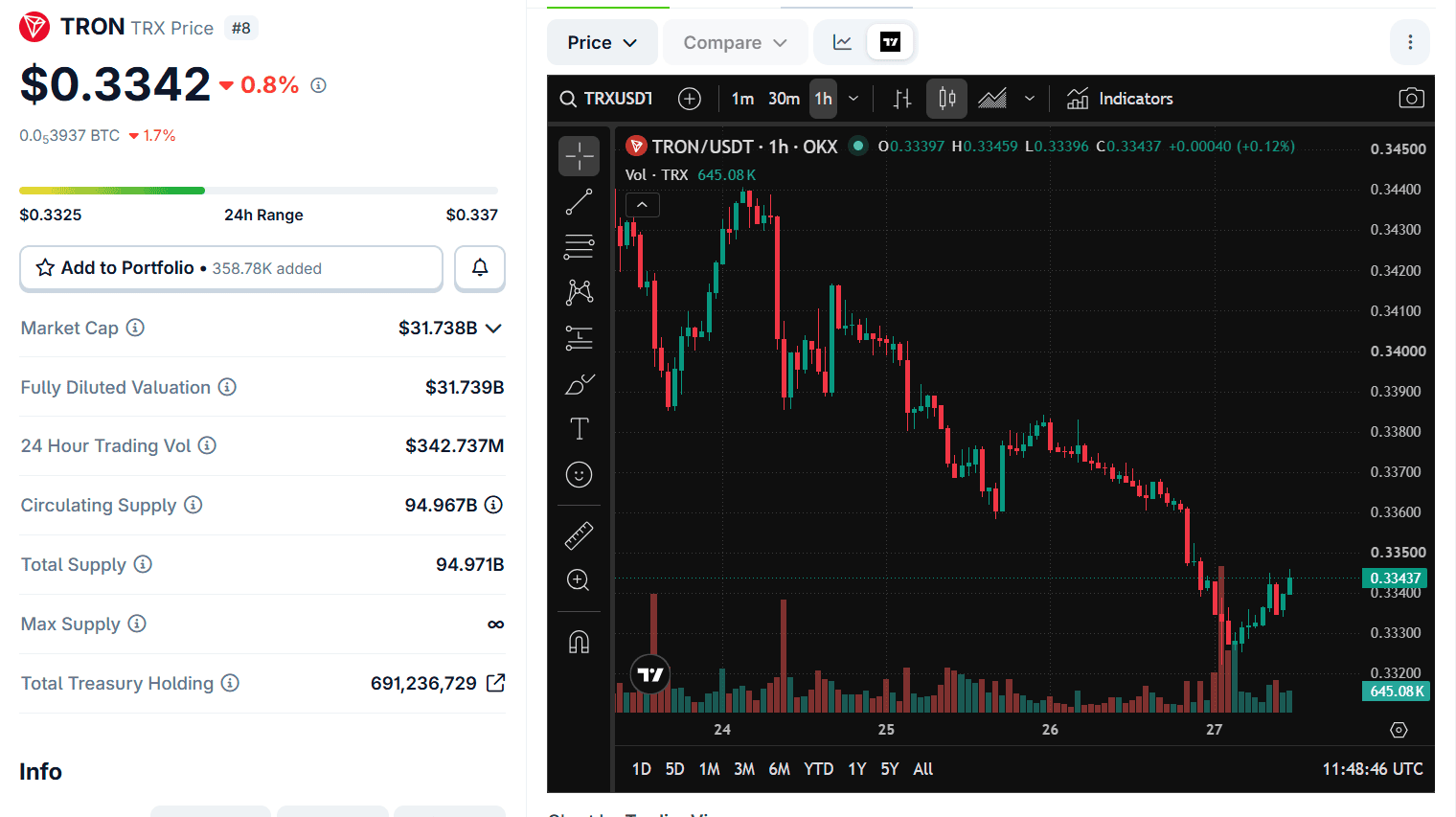
TRX is currently trading around $0.3436 after a modest daily decline. The token has remained within a relatively tight range, with traders watching the area between support and resistance for signs of a larger move.
The 20-day moving average is around $0.3380, while the 50-day average sits near $0.3357. The 200-day moving average is lower at approximately $0.3294.
On the downside, the $0.3355 area is an important level to watch. Resistance is currently positioned near $0.3500.
A sustained move above $0.3500 could bring renewed attention to the recent consolidation range. Trading volume may also become important, as stronger participation would provide additional context around any attempted breakout.
Technical Signals Remain Mixed but Positive
The daily MACD is currently showing a Buy signal, while several other momentum indicators are also pointing toward positive conditions.
However, technical indicators can shift quickly, particularly while an asset is moving sideways. Short-term projections currently place TRX within a range of approximately $0.3376 to $0.3497, making the reaction around these levels worth watching.
Analyst Team LAMBO Charts described TRX as being in a “make-or-break” zone and suggested that a breakout could lead to stronger price movement. This remains a technical view rather than a prediction of what will happen next.
Viktoras Karapetjanc also connected the $30 trillion network milestone with TRON’s underlying activity, suggesting that the current consolidation could represent a period of resetting before another potential move.
For now, TRX remains caught between strong network growth and a price chart that has yet to confirm a breakout. The next move around the $0.3500 resistance area could provide traders with more clarity on the token’s short-term direction.
