


The U.S. Securities and Exchange Commission (SEC) and the Commodity Futures Trading Commission (CFTC) have jointly stated that the majority of crypto assets do not fall under the definition of securities. This announcement builds on earlier guidance released in January 2026, which outlined an initial framework for handling tokenized securities. That document marked the beginning of a broader effort to establish clearer rules for the crypto sector.
According to SEC Chairman Paul S. Atkins, the new interpretation is intended to eliminate long-standing market uncertainty. He explained that regulators are responsible for clearly defining how laws apply, and this step helps participants better understand how crypto assets fit within existing securities regulations. He also noted that many digital assets should not be automatically treated as securities and emphasized that certain investment arrangements tied to these assets may ultimately terminate. Atkins described the move as a transitional step that supports both innovators and investors while lawmakers continue working on comprehensive crypto legislation.
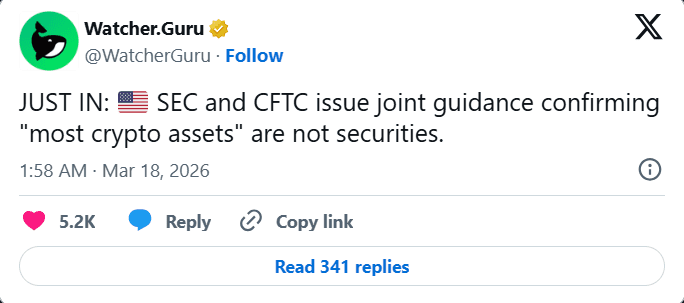
Under its current leadership, the SEC has gradually shifted toward a more supportive stance on digital assets. In the United States, one of the biggest challenges for the crypto industry has been determining whether assets should be classified as securities or commodities, as each classification carries different regulatory consequences. In recent years, disagreements with regulators, particularly the SEC, have created friction for the industry. However, recent policy changes suggest a more favorable environment, positioning the U.S. as an increasingly attractive location for crypto development.
CFTC Chairman Michael S. Selig highlighted that the lack of clear guidance had long been a concern for developers and businesses in the space. He stated that the joint interpretation finally provides the clarity many have been waiting for. Selig also emphasized that both agencies aim to create a balanced regulatory framework that encourages innovation while maintaining oversight. The coordinated effort reflects a shared goal of establishing consistent and practical rules for the evolving digital asset landscape.
