


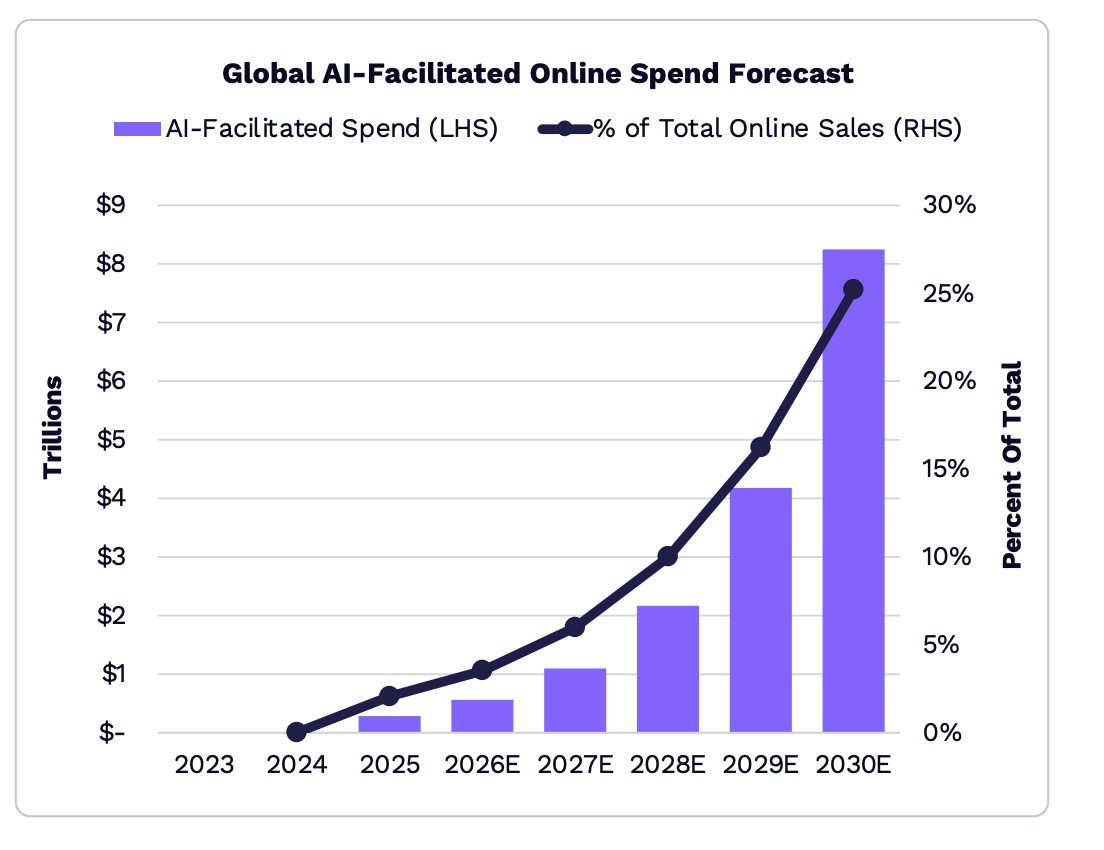
ARK Invest believes artificial intelligence agents may become a major force in digital commerce over the next several years, potentially driving as much as $8 trillion in online consumer purchases by 2030.
The forecast underscores the rapid expansion of AI-powered shopping tools as technology companies race to build systems capable of supporting autonomous online transactions.
AI Agents Expected to Transform Digital Commerce
In its recent Big Ideas 2026 report, ARK Invest predicted that AI agents will increasingly influence how consumers shop online. The firm estimates that AI-assisted transactions could grow from roughly 2% of total online spending in 2025 to nearly one-quarter of all digital commerce by the end of the decade.
The report also highlighted significant momentum in AI-enhanced search technologies. ARK projects that AI-based search platforms may rise from around 10% of global search activity in 2025 to approximately 65% by 2030.
According to the investment firm, advertising tied to AI-driven search is expanding rapidly, with annual growth rates approaching 50%. ARK added that AI-focused advertising platforms are expected to capture market share from traditional search advertising, with revenue gains likely following after a short delay.
In addition, ARK estimated that revenue generated through AI-mediated consumer interactions could climb from about $20 billion today to nearly $900 billion by 2030, representing extremely rapid long-term growth.
Companies Build Infrastructure for AI-Powered Payments
As interest in autonomous commerce grows, major companies are introducing tools designed to help AI agents complete transactions independently.
On May 7, Amazon Web Services unveiled AgentCore Payments, a service intended to give AI agents the ability to purchase digital services such as APIs, online content, MCP servers, and even interactions with other AI systems.
Brian Foster, Coinbase’s Head of Infrastructure Growth and Strategy, said the number of AI agents conducting transactions could eventually surpass human users. He noted that these systems require internet-native financial infrastructure that is programmable, globally accessible, and continuously available.
Other organizations are also entering the space. The Solana Foundation and Google Cloud recently launched Pay.sh, a platform aimed at enabling AI agents to make stablecoin payments through the Solana blockchain. Meanwhile, Anchorage Digital introduced a new offering focused on agentic banking services.
Together, these developments point toward a future where stablecoins and crypto-based payment networks could become a key foundation for AI-driven online commerce.
