


Charlie Lee, the creator of Litecoin, has warned that the roughly 1.1 million Bitcoin believed to belong to Satoshi Nakamoto may be among the first assets threatened if quantum computers eventually break modern cryptography.
His comments highlight a difficult issue for Bitcoin’s decentralized community. If Satoshi is no longer alive or cannot access those wallets, the coins cannot be moved to safer addresses. Any attempt to freeze them would also challenge Bitcoin’s core principle that no authority controls the network.
Why Satoshi’s Bitcoins Could Be More Exposed
In an interview with BeInCrypto, Lee said that although quantum computers theoretically have the power to defeat today’s encryption systems, current machines are still far from capable of doing so. Even so, he warned that the potential impact would extend beyond cryptocurrencies and could affect global financial systems, communications networks, and digital security as a whole.
For the crypto sector, the risk is particularly serious. If quantum machines could break wallet encryption, attackers might gain the ability to access funds without permission, which would undermine the trust that cryptocurrencies rely on.
However, Lee noted that not every wallet is equally vulnerable.
According to him, the Bitcoin addresses linked to Satoshi are less protected than most modern wallets. If quantum attacks ever become practical, those coins might be among the first to be targeted.
Early Bitcoin Address Types Create Weakness
The issue is related to how Bitcoin transactions were structured in the network’s early years.
During 2009 and 2010, most transactions used a script format called Pay-to-Public-Key (P2PK). Later, Bitcoin adopted a more secure format known as Pay-to-Public-Key-Hash (P2PKH).
The difference is significant:
P2PK: The transaction directly reveals the public key.
P2PKH: The transaction stores only a hashed version of the public key, keeping the actual key hidden until the coins are spent.
Because many of Satoshi’s coins are stored using the older format, they may be easier targets if quantum computers eventually become powerful enough to break the encryption.
A recent report from ARK Invest and Unchained estimates that around 6.9 million Bitcoin could potentially be vulnerable to quantum threats in the future. Roughly 1.7 million of those coins are believed to be in early address formats like P2PK and may already be lost.
A Major Governance Problem for Bitcoin
Beyond the technical risk, Lee pointed out that the bigger challenge is deciding how the Bitcoin network should respond.
Even if developers introduce quantum-resistant wallet technology, the question remains: what should happen to coins that cannot be upgraded, including Satoshi’s holdings?
If the creator of Bitcoin is no longer able to access those wallets, the coins could effectively become available to anyone who manages to build a powerful enough quantum computer. In such a scenario, a sudden release of about a million BTC could shock the market.
The community would face several controversial choices:
Modify Bitcoin to prevent anyone from spending those coins
Attempt to move them to safer addresses
Leave them untouched and accept the risk
Each option conflicts with some aspect of Bitcoin’s decentralized philosophy.
If the system truly has no central authority, then no one should have the power to interfere with those funds.
Debate Already Emerging in the Bitcoin Community
The topic has recently resurfaced in discussions among industry figures. CryptoQuant CEO Ki Young Ju suggested that implementing quantum-resistant upgrades could force the network to freeze certain older wallets, including those associated with Satoshi.
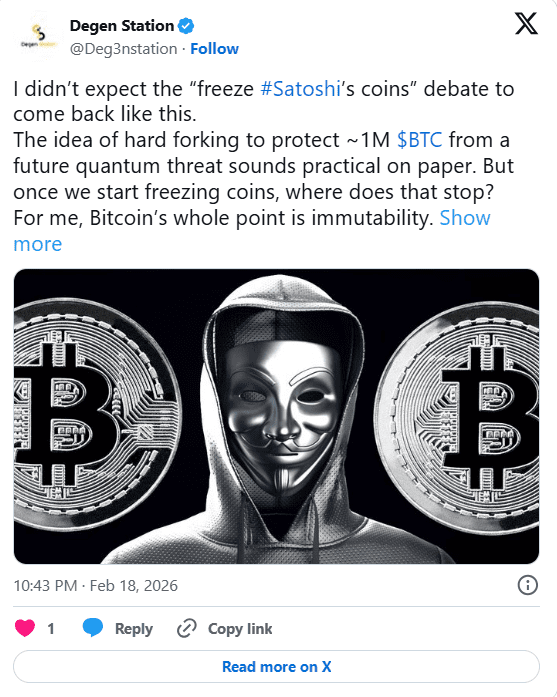
That approach, however, would likely affect millions of other coins stored in early address formats.
Meanwhile, André Dragosch, head of research for Europe at Bitwise Asset Management, has argued that Bitcoin should avoid forcing upgrades on users.
Quantum Computing Is Still Far Away
Despite the concerns, most experts believe the threat remains distant.
According to ARK Invest’s analysis, breaking Bitcoin’s elliptic curve cryptography would require at least 2,330 logical qubits and potentially millions or even billions of quantum operations. Today’s quantum computers only operate with systems measured in the hundreds of qubits.
Still, some institutional investors are already factoring in the possibility.
Earlier this year, Jefferies strategist Christopher Wood reportedly removed a 10% Bitcoin allocation from a key investment portfolio due to concerns about quantum risks.
Investor Kevin O’Leary has also said that some institutions are limiting their Bitcoin exposure for similar reasons.
Litecoin Could Test Solutions First
Lee added that Litecoin may experiment with quantum-resistant features earlier than Bitcoin. Because Litecoin operates on a smaller
network, it can adapt to changes more quickly.
If those upgrades work successfully on Litecoin, the results could eventually guide similar changes in Bitcoin, since both networks share many technical similarities.
A Decision That Could Shape Bitcoin’s Future
For now, the roughly 1.1 million Bitcoins believed to belong to Satoshi Nakamoto remain untouched, just as they have for more than a decade.
But the long-term question remains unresolved:
Should the network protect those coins even if it requires changing Bitcoin’s rules, or maintain its decentralized principles and accept the possibility that they could one day be compromised?
The answer could ultimately shape how Bitcoin defines itself in the era of quantum computing.
