


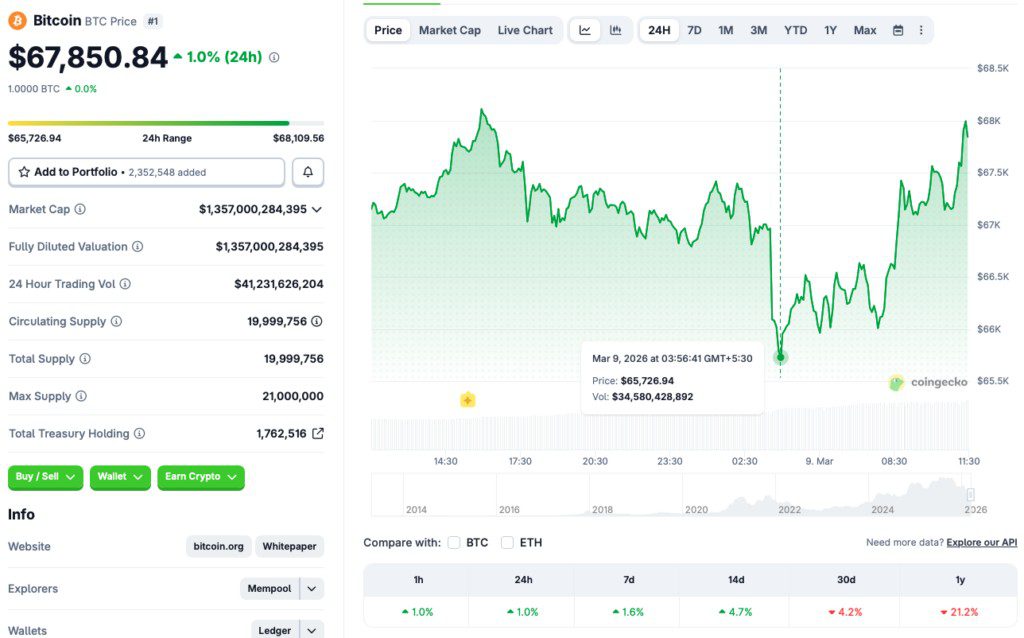
Bitcoin (BTC) recently attempted to break past the $73,000 level for the third time in about a month but was unable to sustain the move. Earlier today, the cryptocurrency briefly dropped to around $65,000 before recovering slightly and moving back above $67,000.
Recent market data shows that Bitcoin has gained roughly 1% over the past 24 hours, about 1.6% over the last week, and close to 4.7% over the past two weeks. Despite these short-term gains, the broader trend remains weaker. Bitcoin is still down about 4.2% over the past month and more than 21% compared to its price in March 2025.
Although the asset has faced notable volatility in recent months, some analysts believe the market could see even deeper corrections ahead, with projections suggesting a potential drop toward the $45,000 level.
Could Bitcoin Drop Below $45,000?
Bitcoin has been trending downward since reaching a record high near $126,080 in October 2025. During February 2026, the price fell twice to around $62,000 before rebounding. This repeated bounce suggests strong support around that range, while the $73,000 level appears to be acting as a significant resistance point.

Several factors have contributed to the recent downtrend. These include broader economic uncertainty, global geopolitical tensions, and reduced market liquidity. Ongoing international conflicts have also added pressure to financial markets, leading to increased selling across risk assets, including cryptocurrencies. Traditional stock markets have experienced similar stress.
Market sentiment data from prediction platforms such as Polymarket indicates that traders are assigning a meaningful probability to Bitcoin falling below $45,000. If the asset were to drop from current levels to that price, it would represent a correction of roughly one-third.
Some analysts hold an even more pessimistic outlook. Researchers at the financial firm Stifel have suggested Bitcoin could decline as low as $38,000 at some point this year. A move to that level would imply a drop of about 44% from current prices.

While these projections reflect bearish scenarios, cryptocurrency markets are highly volatile, and price movements can change rapidly depending on market conditions and investor sentiment.
