


Arthur Hayes has expanded his Ethereum holdings once again, purchasing approximately 1,332.5 ETH, valued at around $2.53 million, according to blockchain tracking data shared on X. The latest acquisition continues a recent accumulation trend that has sparked renewed discussion about Ethereum’s potential role in the next phase of the crypto market.
The BitMEX co-founder had previously sold around 6,000 ETH in June, reportedly realizing a loss of roughly $606,000. However, he reversed that position in July, making several Ethereum purchases that suggest a shift in his market outlook. Ethereum purchases that suggest a shift in his market outlook.
Hayes Continues Building His ETH Position
Today’s transaction follows earlier July purchases totaling nearly 1,939 ETH, which were executed through over-the-counter-style transfers. These moves indicate that Hayes has returned to accumulating Ethereum after exiting his position only weeks earlier.
Arthur Hayes(@CryptoHayes) bought another 1,332.5 $ETH($2.53M) 3 hours ago.https://t.co/gau6egd7Vmhttps://t.co/iKDlaSftbq pic.twitter.com/YKgXPCVe2Z
— Lookonchain (@lookonchain) July 20, 2026
Despite his renewed interest in ETH, some market participants remain cautious. Hayes has previously expressed optimism about cryptocurrencies such as HYPE, ZEC, and WLD before later reducing or closing those positions. As a result, some analysts believe it is too early to conclude whether his latest Ethereum purchases represent a long-term investment strategy or a shorter-term trade.
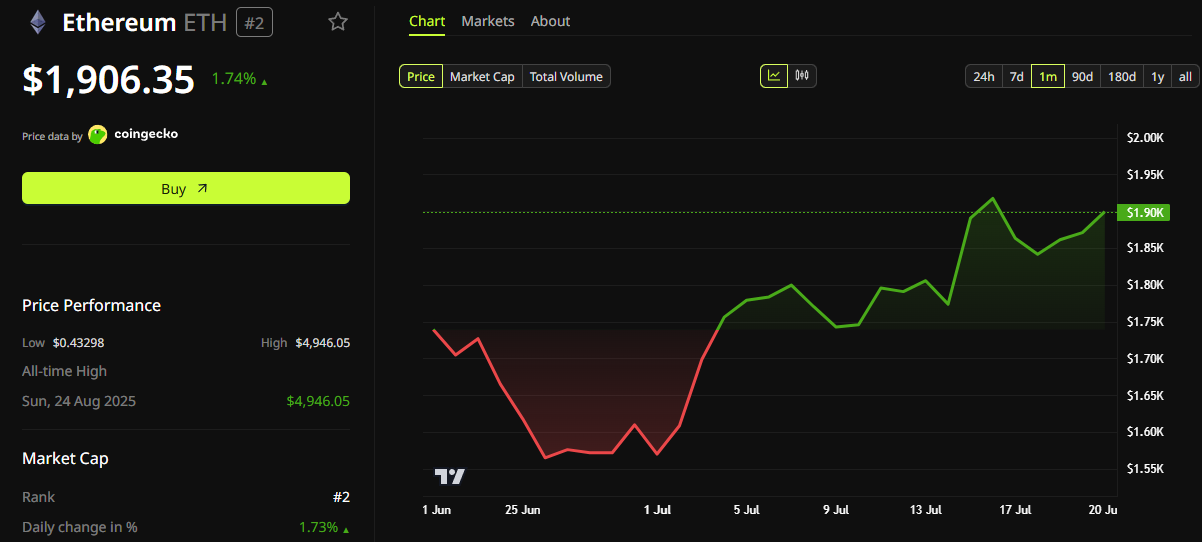
At the time of writing, Ethereum is trading near $1,906, posting a daily gain of approximately 1.7% and maintaining a market capitalization above $230 billion.
Institutional Adoption Strengthens Ethereum’s Investment Case
Beyond Hayes’ activity, many analysts point to increasing institutional participation as a key factor supporting Ethereum’s long-term outlook.
Tom Lee, Chairman of Bitmine Immersion Technologies, has argued that Ethereum’s current growth is increasingly being driven by traditional financial institutions rather than retail crypto investors. He highlights developments such as BlackRock’s tokenized BUIDL fund and Robinhood’s Ethereum-based blockchain initiatives as examples of Wall Street’s growing commitment to the network.
Supporting this trend, Ethereum’s staking participation recently reached a record high, with more than one-third of the total supply now locked in staking, according to CryptoQuant. The launch of staking-enabled investment products has also encouraged greater institutional participation.
Industry analysts have previously estimated that institutional investors and exchange-traded funds collectively control a meaningful share of Ethereum’s circulating supply. Standard Chartered’s Geoff Kendrick has also described Ethereum treasury strategies as an attractive institutional opportunity, citing staking rewards and valuation advantages compared with some competing digital assets.
Looking Ahead
Hayes’ latest Ethereum purchase adds to growing optimism surrounding the asset, particularly as institutional adoption continues to expand. Whether his recent accumulation reflects a long-term conviction or simply a tactical market position remains uncertain. Investors will likely continue watching both on-chain activity and institutional flows for clues about Ethereum’s next major move.
