


Recently, the price of gold has been moving in a slower and more unstable pattern compared to the strong rallies it showed in earlier periods. This is particularly surprising because geopolitical conflicts usually push investors toward safe-haven assets like gold, which typically drives prices higher. Instead of surging, gold’s momentum appears to have cooled. This unexpected behavior has prompted analysts to question why the metal behaves differently during periods of global tension.
Analysts Believe the Current Gold Trend Is Temporary
The present movement in gold prices has puzzled both traders and market observers. In comments shared on the social platform X, market analyst Rashad Hajiyev suggested that gold’s recent performance may be misleading investors. According to him, the market may be interpreting short-term weakness as a sign of decline, while in reality, the metal could be preparing for a much larger move.
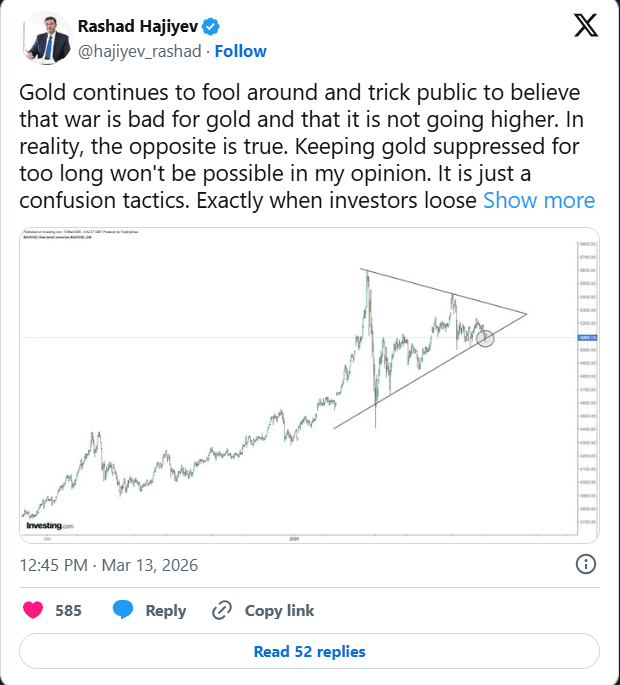
Hajiyev argues that gold’s subdued price action, particularly while the United States dollar remains strong, may create the impression that the metal is losing momentum. However, he believes this phase could simply be part of a broader setup before a significant upward move. In his view, gold may begin rising sharply at the moment when many investors become impatient or lose confidence.
Technical Pattern Suggests a Possible Breakout
Hajiyev also pointed to a technical pattern forming in gold’s chart. He noted that prices appear to be building a classic triangle formation, which traders often interpret as a consolidation phase before a breakout. After a strong rally, assets commonly pause and move sideways for some time before continuing the larger trend.
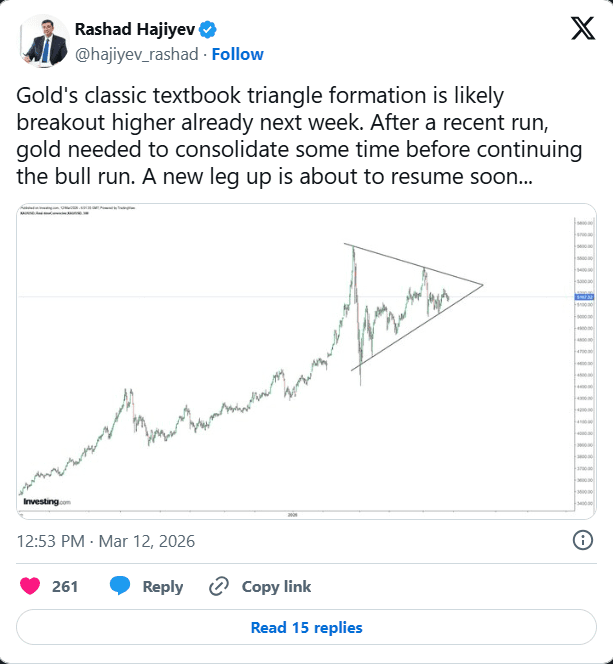
Based on this pattern, he believes gold may soon start another upward phase once the consolidation period ends.
Long-Term Price Targets
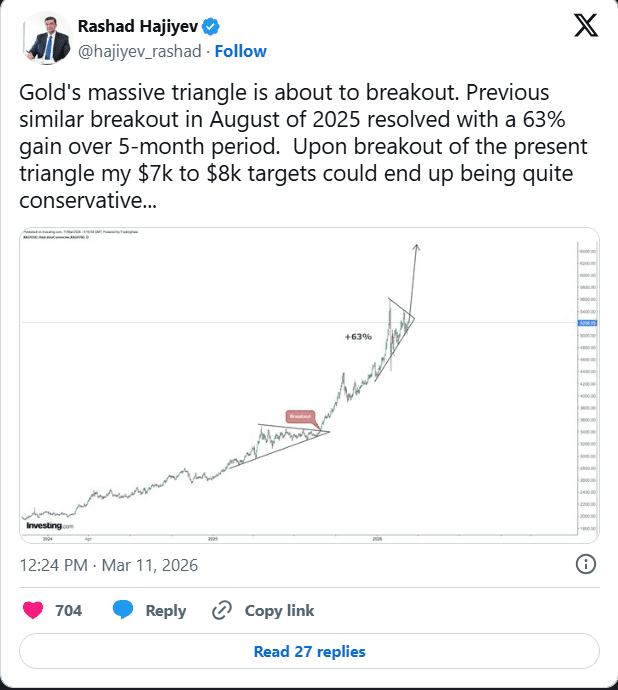
Looking further ahead, Hajiyev suggests that gold could eventually reach a range between $7,000 and $8,000 per ounce if the breakout occurs and the bullish trend continues.
However, major financial institutions have projected more moderate price levels. Investment banks such as Goldman Sachs and JPMorgan Chase have forecast that gold might reach approximately $5,400 and $6,300, respectively, by the end of 2026.
