


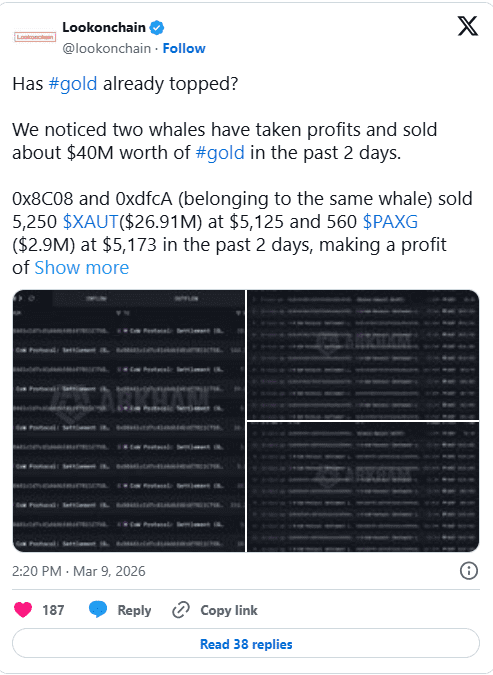
Large holders of tokenized gold have liquidated roughly $40 million worth of positions over two days while the metal traded above $5,000 per ounce, raising speculation that some major investors may be locking in profits near a potential short-term peak.
The transactions were flagged by blockchain analytics firm Lookonchain, which observed activity across several wallets holding Tether Gold (XAUT) and PAX Gold (PAXG) digital tokens that are each backed 1:1 by physical gold reserves.
Major Wallets Secure Multi-Million Dollar Gains
Two wallets, labeled 0x8C08 and 0xdfcA and believed to be controlled by the same entity, sold a combined 5,250 XAUT at around $5,125 per token and 560 PAXG at approximately $5,173.
The sales totaled nearly $29.8 million, generating an estimated $5.3 million in profit for the holder.
Shortly afterward, another wallet (0x8844) sold 1,934 XAUT at about $5,037, bringing the combined liquidation across both parties to roughly $40 million. That trade reportedly produced around $1.7 million in gains.
These transactions took place as the global gold price moved past a level that many analysts had not anticipated earlier in the year.
Despite the sizable exits, some market observers caution against interpreting the activity as a bearish signal.
Gold’s recent rally has been fueled by several macroeconomic pressures, including:
- rising geopolitical tensions
- Disruptions in energy supply
- Ongoing gold purchases by central banks
Analysts say these factors point to long-term structural demand rather than speculative momentum.
Ole Hansen, head of commodities strategy at Saxo Bank, noted that short-term forces may temporarily weigh on prices.
According to Hansen, gold initially weakened as oil prices surged because higher energy costs could boost inflation and reduce expectations for interest-rate cuts. However, he suggested the current situation reflects a supply shock rather than stronger economic demand, which could increase the risk of stagflation and eventually push central banks toward supportive policies.
In the near term, Hansen added, deleveraging and a stronger U.S. dollar could create downward pressure, even though the long-term drivers that have drawn investors to hard assets remain in place.
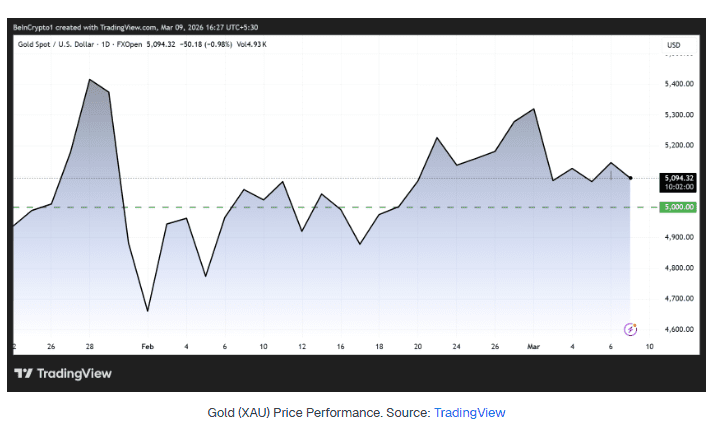
Macro analyst Shanaka Anslem offered a broader interpretation of gold’s move above $5,000.
Rather than a typical safe-haven rally, he views the surge as part of a system-wide repricing of financial risk, driven by multiple stresses in global institutions such as energy supply chains, insurance markets, and international trade routes.
Anslem highlighted developments such as disruptions in shipping insurance coverage and concerns about the Strait of Hormuz, along with the U.S. Federal Reserve’s policy challenges ahead of its March meeting.
He also pointed to projections from J.P. Morgan, which reportedly set a year-end gold target of $6,300, as well as strong sovereign demand. Central banks purchased about 863 tonnes of gold in 2025, with China’s People’s Bank of China extending its buying streak to 16 consecutive months.
Other countries increasing reserves include Poland, India, and Turkey, reinforcing the view that government demand, not retail speculation, is supporting prices.
Profit Taking vs Long-Term Demand
- The recent whale sales illustrate a familiar pattern in commodity markets:
- Large private investors may realize profits after sharp rallies
- Institutions and central banks often continue accumulating over longer timeframes
Whether the $40 million in tokenized gold sales represents a local market top or simply a short-term portfolio adjustment could depend on several factors, including:
How quickly will global energy supply disruptions ease
whether the U.S. dollar continues strengthening or begins to weaken again
For now, the economic backdrop that pushed gold past $5,000 per ounce, including inflation risks and geopolitical uncertainty, remains largely unresolved.
