


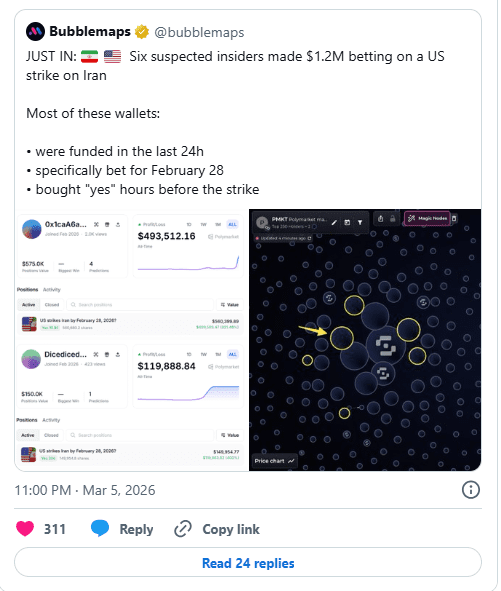
A group of cryptocurrency wallets reportedly earned about $1.2 million on the prediction platform Polymarket after wagering that the United States would strike Iran on February 28. Blockchain investigators later discovered that several of the wallets appeared to be linked and had a history of accurately predicting military actions involving both the U.S. and Israel.
The situation has intensified concerns about possible insider trading on prediction markets, where anonymous accounts and easy access can allow traders with privileged information to profit before events become public.
Highly Timed Bets Raise Questions
According to analysis by blockchain monitoring firm Bubblemaps, six wallets involved in the February 28 market were funded shortly before placing their wagers. Each purchased contract predicted that a U.S. strike on Iran would occur by that exact date.
These positions were opened only hours before reports of the airstrikes emerged, raising suspicion that the traders may have known about the operation in advance.
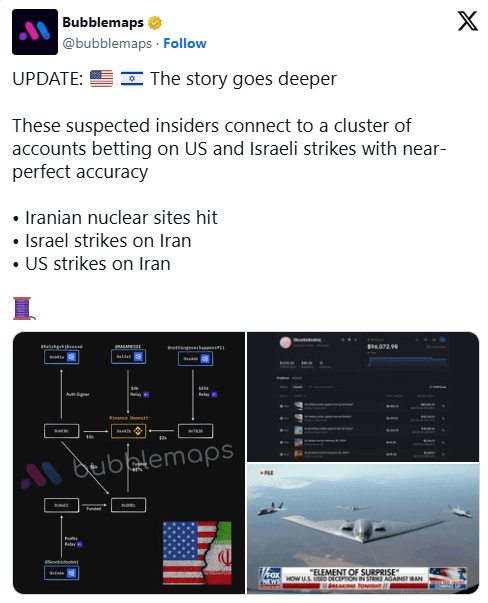
Investigators traced funds from one of the wallets after the profits were withdrawn from the platform. The money trail led to another account via a shared deposit address on a major crypto exchange, suggesting that multiple accounts may have been controlled by the same operator.
That second account had previously made about $100,000 by betting on two separate surprise military actions against Iran in 2025. One of those events was Israel’s launch of Operation Rising Lion in June. Eight days later, the United States joined the conflict, deploying B-2 bombers against Iranian nuclear facilities.
Further blockchain analysis identified two more accounts linked to the same cluster. One reportedly earned around $65,000 on the February 28 strike prediction, while another gained roughly $10,000 by correctly betting on Israel’s earlier attack.
Altogether, four connected accounts generated about $240,000 by forecasting U.S. and Israeli strikes with remarkable accuracy. The full group of six wallets ultimately collected around $1.2 million from the February 28 market alone.
Prediction Markets Under Growing Scrutiny
The discoveries come shortly after authorities brought legal charges in a related case.
In February, Israeli prosecutors accused two individuals, an army reservist and a civilian, of placing prediction-market bets using confidential military information. Investigators alleged the suspects used knowledge obtained through their duties to gamble on the timing of Israel’s initial strike on Iran during a 12-day conflict earlier in the year.
While that case marked one of the first criminal actions tied to prediction-market betting on military events, concerns about suspicious trades have been circulating for some time.
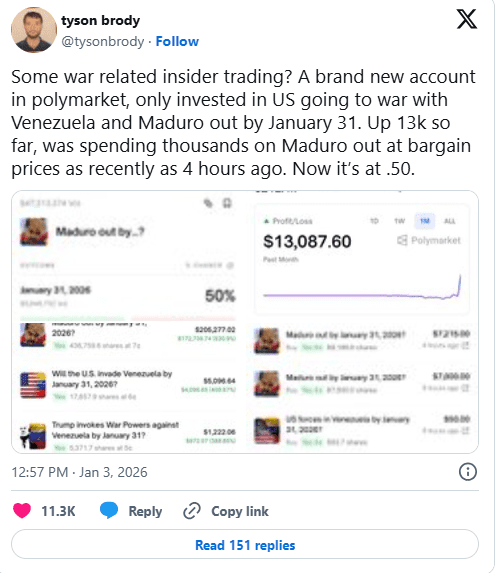
Earlier in January, a group of newly created Polymarket accounts reportedly made more than $630,000 by wagering that Venezuelan president Nicolás Maduro would be captured. The bets were placed only hours before the news became public.
Information Markets or Insider Advantage?
These episodes have reignited debate over the role of prediction markets. Supporters argue that such platforms efficiently gather information from many participants and produce accurate forecasts.
Critics, however, warn that the same systems may reward individuals who possess non-public knowledge, effectively turning geopolitical events into opportunities for insider profit.
As large sums continue flowing into markets tied to political and military developments, regulators and analysts are increasingly questioning whether stronger oversight is needed.
