


Core Scientific recently revealed plans to liquidate most of its Bitcoin holdings to support its expansion into artificial intelligence (AI) and high-performance computing. The decision highlights a growing shift within the Bitcoin mining sector while also raising fresh questions about the long-term role of corporate Bitcoin treasuries during periods of market weakness.
Core Scientific Sells Bitcoin to Fund Expansion
Earlier this week, Core Scientific confirmed it would allocate proceeds from recent Bitcoin sales toward building out its data center infrastructure. According to its latest 10-K filing, the firm sold 1,924 Bitcoin between December and February, generating approximately $176 million in total proceeds.
Data from Bitcoin Treasuries shows the company now holds 613 Bitcoin, valued at roughly $42 million.
In addition, Core Scientific announced that its Pecos, Texas, facility will transition from Bitcoin mining operations to colocation services. This move aligns with increasing demand for AI-focused computing infrastructure.

The pivot mirrors a broader industry pattern, as miners explore alternative revenue streams amid lower Bitcoin prices and rising energy expenses. By late 2025, mining profitability had reportedly dropped to record lows, with a significant portion of leading mining firms generating revenue from infrastructure and hosting services.
Core Scientific joins companies such as CleanSpark, Riot Platforms, and IREN in diversifying beyond traditional mining operations.
However, this latest development also reflects more than operational restructuring; it suggests a reduced emphasis on long-term Bitcoin accumulation.
Bitcoin Stagnation Pressures Digital Asset Treasuries
Before its recent divestment, Core Scientific was not among the largest corporate holders of Bitcoin. Rankings from Bitcoin Treasuries place it 59th among the top 100 publicly traded companies holding Bitcoin.
Still, the scale of the sell-off has fueled debate about the sustainability and profitability of digital asset treasuries (DATs).
Around the same time, MARA Holdings updated its treasury guidelines to allow the sale of Bitcoin held directly on its balance sheet. The shift marks a notable change from its previous full “HODL” approach and has intensified speculation that other corporate holders could reconsider their policies.
Bitcoin’s recent price performance has added to these concerns. Trading near $68,000 at the time of reporting, the cryptocurrency has declined significantly over the past one and three months. The likelihood of revisiting its previous all-time high of $126,000 appears increasingly uncertain.
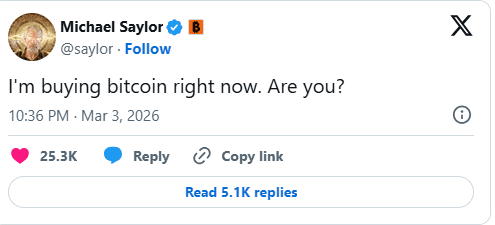
Meanwhile, Strategy, formerly known as MicroStrategy, continues to stand firmly behind its Bitcoin strategy. Founder Michael Saylor reiterated his support for the asset this week, publicly affirming ongoing purchases.
At the same time, volatility surrounding Strategy’s stock (MSTR) has prompted questions about investor sentiment. In November, CEO Phong Le acknowledged that under extreme financial stress, the company could potentially sell portions of its Bitcoin reserves.
As more firms reassess their treasury strategies, the future direction of digital asset treasuries may depend heavily on Bitcoin’s market trajectory and the evolving economics of mining and infrastructure services.
