


Mentions of “World War 3” are exploding across crypto-focused social media, according to insights from on-chain analytics provider Santiment. The level of discussion has climbed to its highest point since June 2025, signaling a sharp rise in anxiety among online traders.
The timing is notable. The surge follows coordinated military strikes involving the United States and Israel against Iran, along with retaliatory missile and drone attacks across parts of the Gulf. While the worst-case scenario dominates online chatter, price action suggests traders are reacting very differently with their capital.
Rising Geopolitical Tensions Fuel Online Fear
The renewed conflict has reopened fresh wounds from last year’s June 13–24 confrontation, when Israeli strikes on Iranian nuclear and military targets triggered direct retaliation. The U.S. played a defensive role, intercepting incoming attacks before later launching its own strikes, prompting Iran to target regional assets, including a U.S. base in Qatar. A ceasefire eventually followed on June 24.

That history helps explain why global search interest for “World War 3,” as tracked by Google Trends, is climbing toward levels last seen during that earlier flare-up.
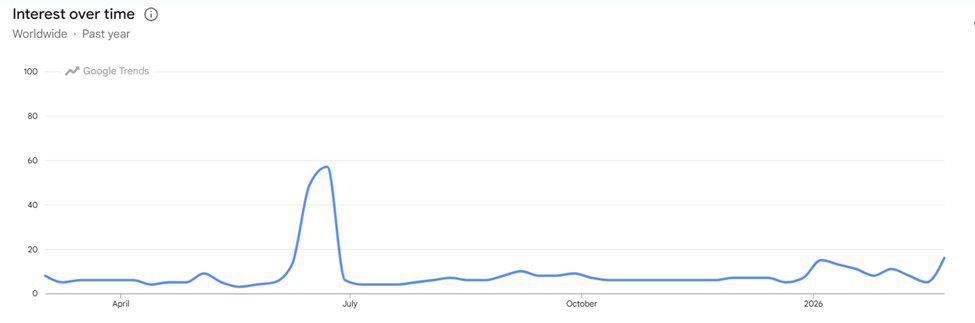
Santiment noted that uncertainty surrounding the current conflict, combined with lingering memories of the previous 12-day exchange, has intensified fear-driven narratives online. Many posts increasingly frame the situation as a possible gateway to a much broader global conflict.
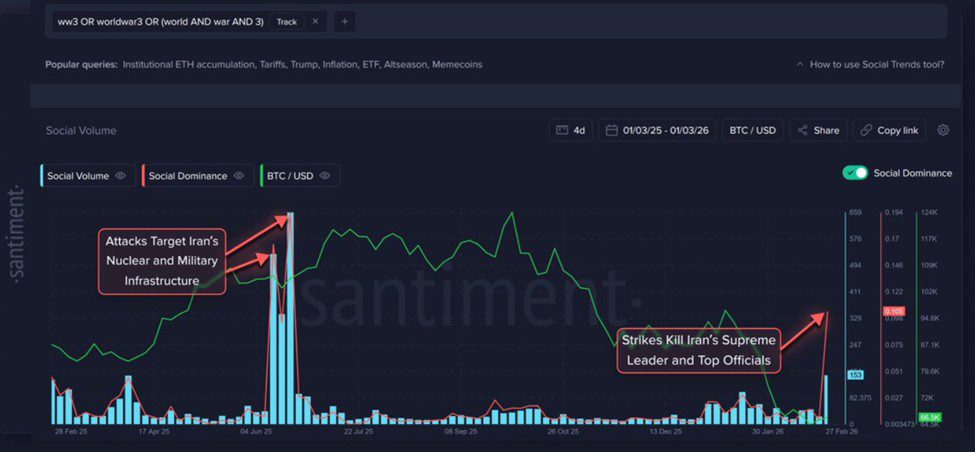
Markets Show Little Sign of Panic
Not everyone is buying into the doomsday narrative. Macro-focused outlet The Kobeissi Letter argues that financial markets are signaling restraint rather than alarm.
Oil prices initially jumped following the headlines, but have already given back nearly half of those gains. U.S. equities remain down less than 1%, gold is up roughly 2%, and Bitcoin has even edged into positive territory on the day, based on data from TradingView.
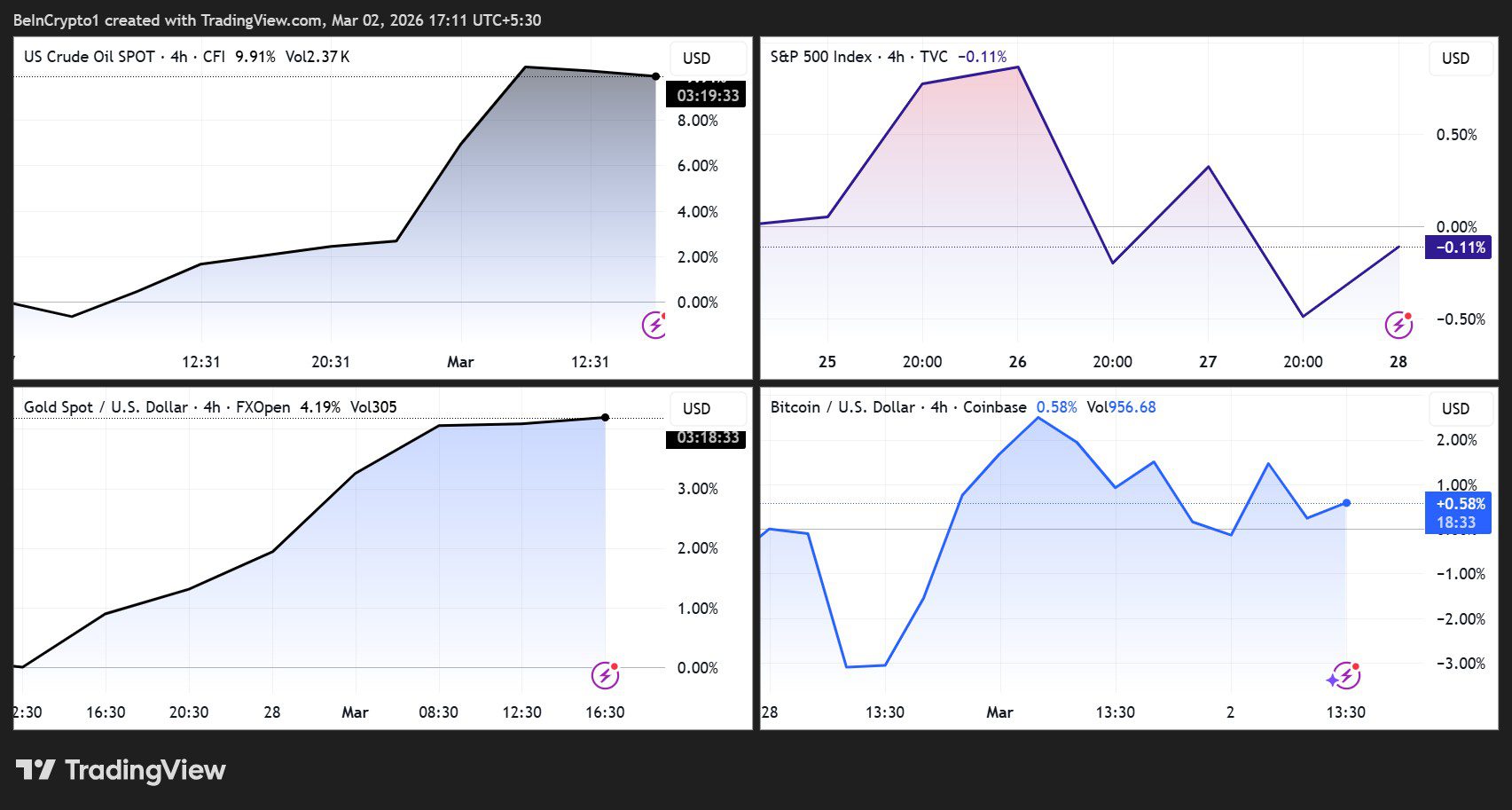
“Don’t panic. The dust will settle,” the outlet wrote, pointing to the widening gap between emotional online discourse and actual market behavior.
Market analyst Kyle Doops added that while oil grabs attention during geopolitical shocks, gold often provides a clearer long-term signal. During previous stress periods, including World War I, World War II, and the inflation-heavy 1970s, gold’s share of global market value expanded sharply. Today, despite record debt levels and rising geopolitical risks, gold remains far below those historical extremes.
Within crypto circles, opinions are mixed. Some traders argue that retail participants tend to react emotionally, while larger players accumulate quietly during periods of fear.
“Volatility is baked in,” one trader wrote, noting that sentiment often overshoots reality before prices catch up.
On-Chain Data Points to Seller Fatigue
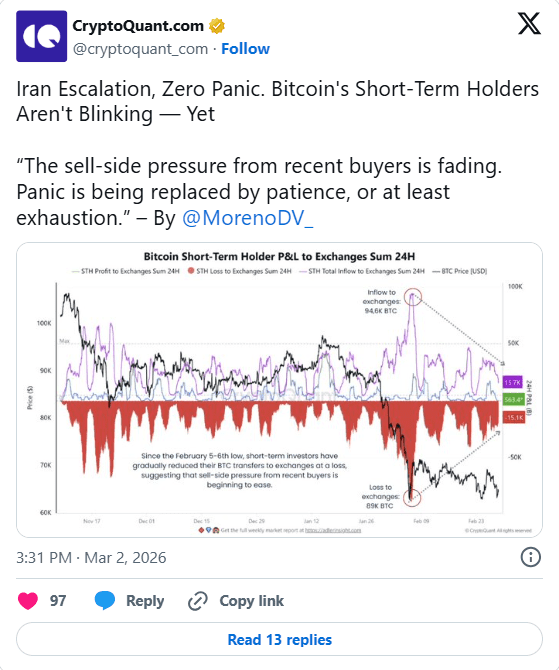
Blockchain analytics from CryptoQuant support the calmer interpretation. The firm reports that Bitcoin’s short-term holders, typically the most reactive group, are not rushing to sell.
CryptoQuant’s Short-Term Holder P&L to Exchanges metric, which tracks loss-driven selling from recent buyers, shows declining sell pressure since the February 5–6 capitulation event. That episode saw roughly 89,000 BTC moved to exchanges at a loss within a single day.
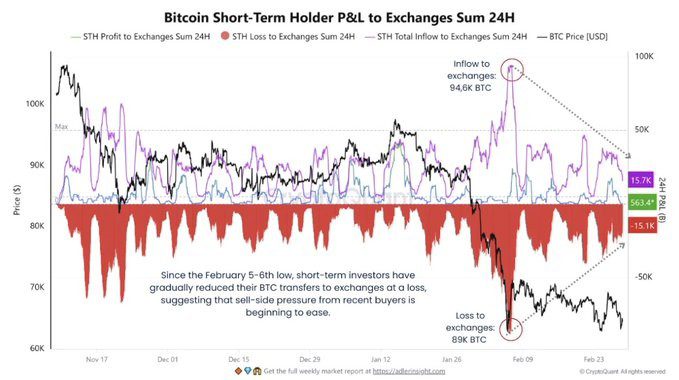
Since then, loss-driven inflows have steadily decreased. Even as Bitcoin dipped toward the $63,000–$64,000 range during the latest escalation, there was no meaningful spike in exchange deposits from short-term holders.
“No panic profit-taking, no loss capitulation,” the firm observed.
Historically, once forced selling subsides, and weaker hands exit, markets tend to find stability. While crypto social media may be bracing for World War III, price action across Bitcoin, equities, gold, and even oil suggests expectations of a more contained outcome.
The key indicator to watch next is whether short-term holder inflows remain subdued. If panic selling continues to stay absent, the current fear wave may prove to be another sentiment spike, not the beginning of a systemic breakdown.
